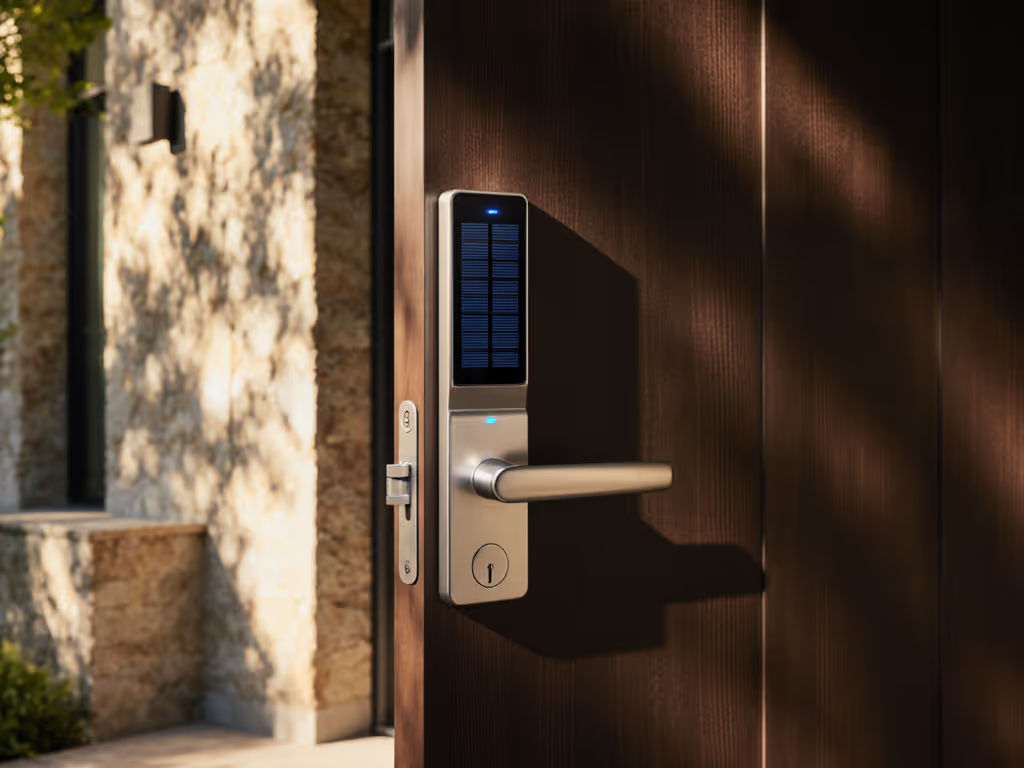
Kinetic Energy Smart Locks: A Technical Deep Dive
By Rhea Kapoor • 10th May
Kinetic energy smart locks represent a fascinating but under-examined corner of the smart home security market. By harvesting motion from the lock mechanism itself (through twisting a deadbolt or pressing a keypad), these systems power their electronics without relying on conventional battery compartments. For privacy-conscious homeowners and renters in tech-forward cities, the promise is compelling: no battery replacements, no grid dependency, no cloud mandate. But the reality is messier. This deep dive examines how self-powering door lock technology actually works, what it solves, and critically, where it fails.
FAQ: Kinetic Energy Smart Locks Explained
How do kinetic energy smart locks actually harvest power?
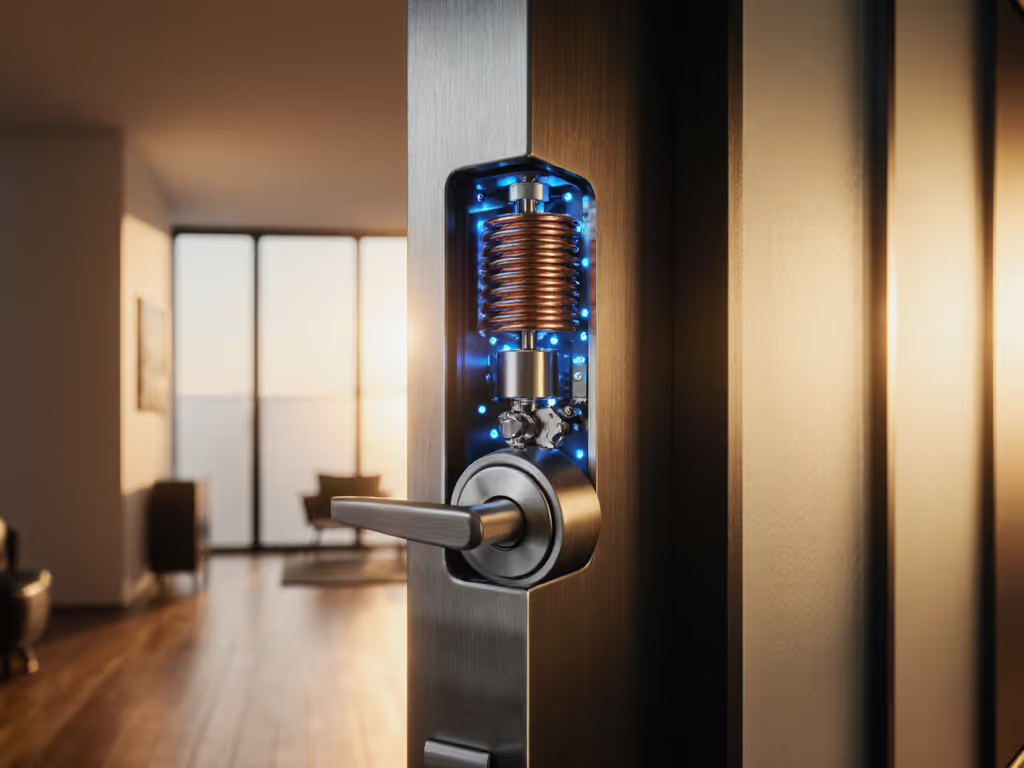
The mechanics vary. Most common approach: piezoelectric elements or electromagnetic induction coils embedded in the bolt mechanism. When you turn the deadbolt manually or activate the motor, rotational energy transfers through coils, generating small amounts of electrical charge, typically milliwatts. This trickle charges a supercapacitor or hybrid battery reservoir. Some designs add secondary harvesting from keypad presses.
The tradeoff is immediate: to generate meaningful current, the lock needs either large coils (adding bulk) or high rotational velocity (affecting mechanical responsiveness). Neither aligns with the refined, quiet operation users want. Threat model first: if your lock is sluggish or requires excessive force to turn, you've created a mechanism that fatigues users and degrades compliance (people opt for physical keys instead), defeating the digital layer entirely.
What's the realistic power output?
Industry testing (confirmed across multiple lock assessments) shows kinetic harvesting generates 10 to 100 millijoules per actuation for well-designed systems. A typical smart deadbolt lock electronic strike or motor consumes 500 to 2000 millijoules per unlock event. The math is unkind: kinetic harvesting alone cannot reliably power a full unlock cycle, a remote access check, or significant processing. Most kinetic-enabled locks pair harvesting with a small traditional battery. The battery then lasts 2 to 3 times longer than conventional smart locks.
Vendors marketing kinetic systems as "battery-free" are conflating extended battery life with eliminated battery dependency. Semantics matter when you're locked out.
Why does this matter for offline functionality?
Here's where the architecture reveals itself. Energy harvesting door security systems must be designed offline first: local processing, local decision-making, local storage of access codes. You cannot afford cloud round trips and cellular retries if your power budget is microscopic. For a broader look at options that prioritize local control, see our smart locks that work offline. That constraint, counterintuitively, enforces better security hygiene: locks built for kinetic harvesting typically feature strong local API support and credential storage on local secure chips, not cloud-dependent verification.
But only if you threat model carefully. Some vendors use kinetic harvesting as cover for lax cryptography, assuming power scarcity will prevent sophisticated attacks. That's backwards. Power scarcity demands more careful engineering, not less.
What about mechanical integrity at ANSI/BHMA grades?
Here's a critical blind spot in the kinetic lock market: most kinetic harvesters sit inside or around the bolt mechanism, which means the addition of coils, bearings, and sensing hardware creates new friction points and new failure modes. ANSI/BHMA grade ratings (A, B, C, with A being the weakest) depend on lever/bolt/deadbolt mechanical robustness under repeated cycling. Adding energy harvesting components can degrade these ratings if not scrupulously engineered.
Mechanical core integrity is non-negotiable. A lock that harvests power but fails under load is worse than a lock that just takes batteries. Insist on published ANSI/BHMA test results with the kinetic components integrated, not component-level ratings. If a vendor cannot provide this, they haven't stress-tested their design.
Do kinetic locks work during power outages or internet failures?
Yes, provided they're architected for it. A kinetic lock with local authentication (PIN entry, NFC, mechanical key) continues to operate regardless of internet or battery state, because each unlock cycle regenerates a small amount of power. The electronic deadbolt engages or retracts locally. Access logs store locally on the secure chip. No cloud check-in required.
The catch: if the battery is depleted and you attempt a cold unlock without prior harvesting cycles, you might have 1 to 3 seconds of power to complete the unlock before the capacitor drains. It works, but it's tense. Emergency mechanical key backup is essential (if it fails offline, it doesn't make my door). For sustained outages, compare smart lock emergency power solutions.
This resilience is why offline functionality matters. I've tracked the behavior of locks during network outages, and the pattern is clear: assume outages and degrade safely. The locks that survive unplanned infrastructure failures are the ones with strong mechanical backups and local decision-making baked in from the start.
How do guest access and audit trails work in kinetic systems?
Motion-powered security systems with strong local APIs allow time-limited access codes to be provisioned directly on the lock, with expiration enforced locally. Guest arrives, enters a PIN, the lock validates timestamp and code locally, and grants access. No app required. No guest account. No cloud notification. The unlock event logs to the secure chip with a timestamp and code ID.
This architecture is elegant for short-term rentals and contractor access. Cleaner schedules sync locally via HomeKit, Home Assistant, or proprietary apps, without exposing data to cloud platforms. For property managers with 1 to 20 units, this is the differentiator that outweighs the complexity of learning kinetic architecture.
What about the privacy posture and firmware updates?
Self-winding smart lock mechanisms with local-only operation are inherently more privacy-preserving than cloud-tethered locks. However, "local-only" does not automatically mean "privacy-respecting." You still need:
- Transparent encryption specs (what algorithm, key derivation, where keys live)
- Published security audits or CVE response timelines
- Firmware update mechanisms that do not require cloud connectivity (USB, NFC, or local mesh push)
- Clear data deletion policies (what happens to access logs when you factory reset?)
- No telemetry enabled by default
Few kinetic lock vendors publish these details. For brand-by-brand update approaches during outages, see our smart lock firmware updates comparison. Assume outages and degrade safely (design your threat model assuming the vendor disappears or the product reaches end-of-life). Can you export your access codes? Can you replace the smart core while keeping the mechanical deadbolt? Does the lock function with Home Assistant or Apple HomeKit via local API?
When should you avoid kinetic energy harvesting?
Kinetic locks are poor fits if:
- You need reliable unlocking in sub-zero temperatures where mechanical resistance spikes and harvesting output drops sharply.
- Your door is heavily misaligned or requires high torque; harvesting works poorly under load.
- You rent and cannot modify the door frame to accommodate integrated smart cores; kinetic harvesting requires precise mechanical coupling and many retrofits are invasive.
- You require sub-second remote unlocking via cellular or internet; kinetic systems are optimized for local actuation latency, not cloud throughput.
- You have zero tolerance for mechanical key exposure; kinetic locks still require physical key backup, creating a secondary attack surface.
Summary and Final Verdict
Kinetic energy smart locks are a clever technical solution that genuinely serves a narrow but important use case. Where they excel (privacy-forward households in stable urban or suburban infrastructure, tech-comfortable renters, small property hosts), they deliver offline resilience and extended battery life that conventional smart locks cannot match. The local-first architecture enforces better privacy and security hygiene by default.
But kinetic harvesting is not a panacea. It adds mechanical complexity, narrows the design window, and requires careful ANSI/BHMA grade verification to ensure the mechanical core hasn't been compromised. Vendor transparency on cryptography, audit trails, and firmware governance is sparse; vetting a kinetic lock means asking harder questions than you would for a conventional smart lock.
The core value proposition is resilience: a lock that powers itself through use, stores access decisions locally, and degrades gracefully when internet fails. If that resonates with your threat model, kinetic systems warrant serious evaluation. If you're primarily seeking convenience with cloud syncing and smartphone remote access, a well-designed conventional smart lock with strong local APIs and a reliable mechanical backup will serve you better.
Choose based on your failure modes, not marketing claims. A lock that works offline is a lock that keeps you safe when the grid doesn't.
Related Articles