Smart Lock Emergency Power: Built-In vs External Solutions
By Kenji Sato • 19th Mar
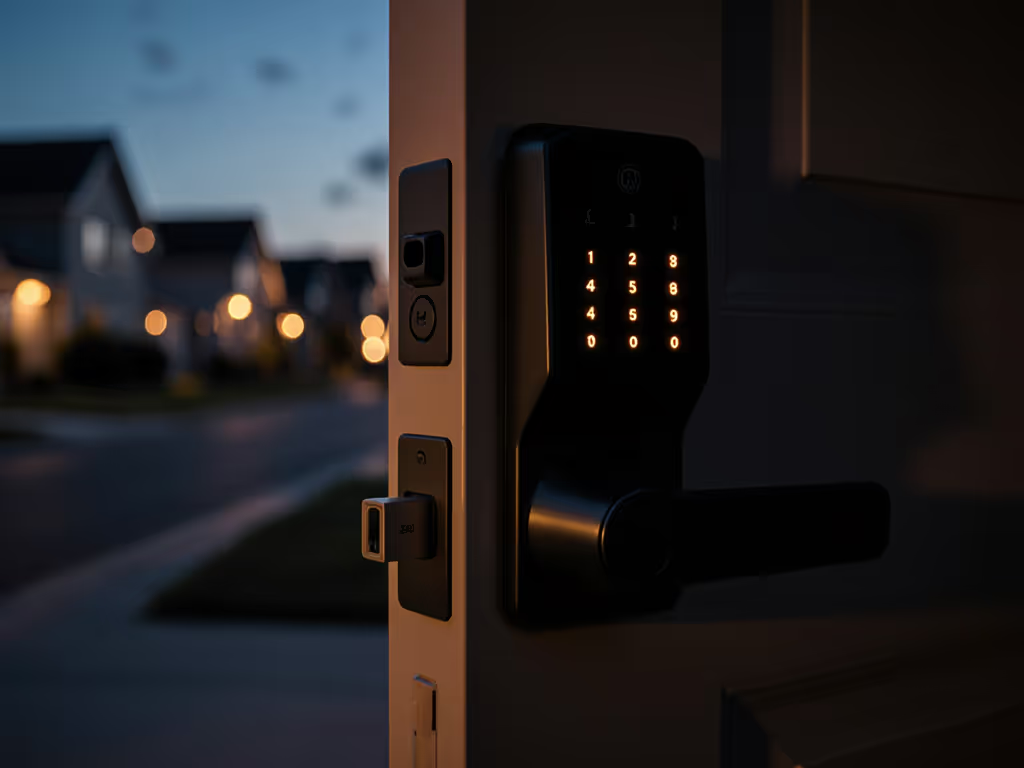
When the grid fails, comparing smart lock emergency power options becomes more than academic. A practical, outage-ready power design separates locks that function as fallbacks from those that become expensive paperweights. This article examines the technical and operational landscape of built-in battery architectures, external power solutions, and the testing regimens that reveal which approach truly survives power loss.
What Are the Core Power Architectures in Smart Locks?
Most residential smart locks operate on one of two fundamental power paradigms: self-contained battery packs designed for months or years of operation, or hybrid systems that pair built-in batteries with external recharge capabilities.
Built-in battery systems typically employ four AA or AAA cells, delivering reliable amperage for solenoid activation and microcontroller operation over extended periods. The Nest smart lock, for instance, uses four AA batteries rated for approximately one year of typical use, paired with a critical feature: external 9V battery recovery. This hybrid approach acknowledges a central truth: even well-engineered battery packs deplete, and users frequently ignore low-battery warnings.
External power solutions include Wi-Fi bridges that enable remote connectivity independent of battery state, backup recharge ports (USB-C or proprietary connectors), and mechanical override pathways. Some manufacturers, like August, integrate a Wi-Fi bridge directly with the smart lock package, allowing basic internet-connected operation without a separate hub purchase.
Why Do Battery Alerts Fail in Real-World Scenarios?
This question cuts to the heart of emergency power reliability. Most locks emit low-battery alerts weeks before depletion (Nest sends warnings about five weeks in advance), yet homeowners still encounter dead locks. The failure modes are predictable:
- Alert fatigue: Users ignore recurring notifications, especially on rarely-checked secondary doors.
- Timing misalignment: Alerts trigger during vacation or periods of travel, when battery replacement is inconvenient.
- False positives in cold climates: Battery voltage drops sharply in freezing conditions, triggering alerts even when residual capacity remains sufficient for critical unlock cycles.
- Firmware delays: Some locks deprioritize alert transmission when connectivity is poor, allowing silent failure.
Danalock, tested extensively through Danish winters below freezing, retained function despite extreme temperature swings. This durability speaks to hardware design but does not eliminate user error.
The deeper issue: relying solely on user vigilance creates a single point of failure. A lock that cannot be accessed when power is exhausted, regardless of warning frequency, transfers operational risk entirely to the end user.
How Do Built-In and External Power Solutions Compare in Outage Scenarios?
Built-In Battery Architecture
Advantages:
- Immediate availability; no setup required.
- Self-contained operation; no dependency on external hardware availability.
- Mechanical backup unlock remains available (physical key) even if the batteries are exhausted.
Disadvantages:
- Battery depletion creates a hard deadline; users must anticipate and act proactively.
- Capacity is finite and unforgiving; a single oversight results in lockout.
- Performance degrades gradually; locks may become slow or unreliable as voltage drops.
- Remote awareness may be limited when you are away; you might not receive alerts in time to respond.
External Power Solutions (9V Backup)
Advantages:
- Emergency recovery is possible after complete battery depletion; a fresh 9V battery often provides enough current to unlock the door once.
- Shifts responsibility from continuous monitoring to occasional emergency action; psychologically and operationally distinct.
- Provides a window of recovery even if battery warnings were missed.
Disadvantages:
- Requires a 9V battery to be on hand or quickly obtained during an outage.
- External power ports (9V terminals, USB-C sockets) introduce mechanical complexity and potential corrosion or damage points.
- User must locate the external port and connect it correctly (which assumes calm, capable action during a stressful lockout).
- Not applicable to locks relying on a single internal battery cell; some designs (Alfred, eufy) use single-cell architectures that cannot be externally charged, leaving users without options during recharge cycles.
Wi-Fi Bridge Dependency
The August Smart Lock Pro and similar designs pair a lock with a Wi-Fi bridge to enable remote unlock and app-based control. This approach separates the lock's local radio (Z-Wave, Thread, or BLE) from internet connectivity, allowing two operational modes:
- Local control: Within radio range, codes and physical keys work regardless of internet status.
- Remote control: Only possible when the Wi-Fi bridge is powered and connected to the internet.
This design is robust for outage scenarios because local function is unaffected by grid failure, provided the lock has battery power. The bridge enhances convenience but does not replace the need for adequate battery capacity.
What Does Outage Performance Testing Actually Reveal?
Outage performance testing should address cold starts, sustained operation under load, and graceful degradation. Testing conducted by professional reviewers often reveals gaps between marketing claims and real-world resilience.
The Yale Assure Lock 2 was noted as the most reliable lock across multiple platforms in real-world testing, while SwitchBot Lock Pro showed status update delays across some platforms, illustrating that software reliability (app responsiveness) is inseparable from hardware robustness.
A comprehensive test battery must include:
- Cold temperature performance: Battery voltage drops significantly below freezing; locks must unlock within reasonable timeframes even in harsh conditions.
- Repeated unlock cycles: Solenoids draw peak current during activation; a battery nearing depletion may fail after several consecutive unlock attempts.
- State persistence during outages: Does the lock log access attempts locally? Can it resume operation once power returns?
- Test cold starts and power cycles: This is non-negotiable. Many locks fail on initial power-on after prolonged depletion. A reset cycle under powered conditions may be required before the lock becomes responsive again.
- External power recovery verification: If external 9V recharge is supported, test actual recovery multiple times; corrosion or misalignment can render the feature inoperable.
Schlage Encode and August Wi-Fi Smart Locks both achieve ANSI Grade 1 ratings, indicating strong physical construction, yet neither rating guarantees predictable behavior under complete battery exhaustion.
How Do Open Standards Affect Power Resilience?
This is where protocol architecture becomes operationally critical. For a deeper dive into connectivity trade-offs, see our Z-Wave vs Wi-Fi vs Bluetooth guide. Locks using Zigbee clusters or Z-Wave S2 security operate within meshed networks where other devices relay commands when direct radio contact is lost. This does not protect against depleted batteries, but it does mean that command delivery is more robust than proprietary, hub-dependent designs.
Danalock's support for both Z-Wave and Zigbee variants (each supporting over 4,000 compatible devices) ensures that if one lock or bridge fails, the broader ecosystem continues to function. This resilience philosophy is foundational: Interoperate today, migrate tomorrow, and stay sovereign throughout.
A lock communicating only through a proprietary bridge creates a hidden dependency. If the bridge loses power or internet connectivity, the lock becomes unreachable even if its battery is adequate. Locks with BLE advertising and local radio protocols (Thread, Zigbee, Z-Wave) remain accessible from nearby devices or controllers, bypassing bridge failure modes entirely.
I learned this lesson through infrastructure necessity. When a vendor killed its bridge service, a client's automations died overnight; smart locks became truly "smart" again only after I rebuilt the system using Zigbee-native locks and a documented, open-source controller running locally. That weekend rebuild vindicated a core principle: open, documented protocols with local API access are the only sustainable foundation.
What Should Users Prioritize When Evaluating Power Resilience?
The decision between built-in and external power solutions hinges on operational philosophy:
Prioritize built-in battery capacity and accurate low-battery alerting if:
- You value simplicity and minimal hardware.
- Your household reliably acts on maintenance alerts.
- You are comfortable with a hard deadline for battery replacement.
Prioritize external power recovery (9V terminals, USB-C recharge ports) if:
- You acknowledge that users inevitably miss warnings.
- You want a literal emergency recovery option.
- Your door may be accessed during outages when battery replacement supplies are unavailable.
Prioritize open-standard locks with local control if:
- You want the lock to remain operational even if internet or a proprietary bridge fails.
- You intend to migrate systems in the future without replacing hardware.
- You value long-term autonomy over initial convenience.
The August Smart Lock Pro pairs Z-Wave compatibility with a Wi-Fi bridge, allowing local unlock via radio while remote access depends on external connectivity. This split-function design acknowledges that outages are real and frequent enough to warrant architectural planning.
What Does the Future of Outage-Ready Design Look Like?
Emerging standards like Matter over Thread introduce mesh networking capabilities that improve resilience compared to hub-dependent ecosystems. A lock supporting Matter over Thread can rely on any Thread-enabled device in the home as a relay, eliminating single points of failure.
However, the current market still conflates convenience with resilience. A lock that requires internet for remote unlock, requires a proprietary bridge for any connectivity, or lacks external power recovery is not outage-ready, regardless of marketing claims about "smart" features.
Future-proofing means selecting locks with:
- Documented, local APIs allowing control from open-source controllers without vendor lock-in.
- Clear ANSI or EN ratings for physical security; these correlate with mechanical robustness.
- Transparent battery capacity and real-world runtime estimates under various usage patterns.
- Detailed local audit logs stored on the device, not dependent on cloud services.
- Explicit support for protocols (Zigbee, Z-Wave, Matter) rather than proprietary or bridge-only designs.
Further Exploration
If your household relies on smart locks during grid failures, the next step is hands-on evaluation. Request product datasheets specifying battery type, expected runtime, and external power recovery procedures. Contact manufacturers directly about cold-weather performance and request references from users in your climate zone. Most importantly: test cold starts and power cycles on your own door hardware before full deployment. A lock that functions flawlessly at 70°F may surprise you at 20°F, and discovery during an actual outage is too late.
Consider your lock's role within a broader ecosystem. Is it a convenience layer atop a mechanical key, or a critical security pathway? That distinction determines whether redundancy is a luxury or a necessity. Open standards and local control are not merely technical preferences, they are insurance policies against vendor decisions, firmware bugs, and infrastructure failures beyond your control.
The most resilient smart lock is one that remains functional when everything else fails, serves as a fallback rather than a dependency, and can be replaced without orphaning your entire home automation infrastructure. That is the standard worth building toward.
Related Articles